
Coaching in the Age of AI. 3 Reasons Why This Work Matters More Than Ever
May 10, 2026
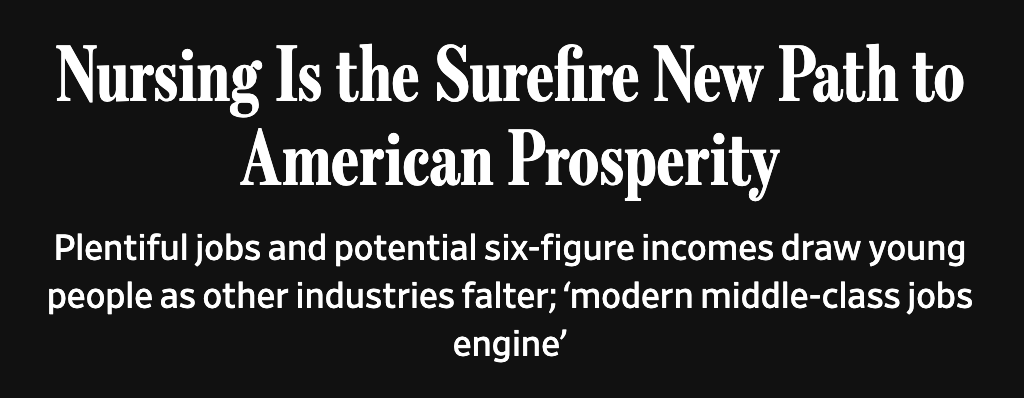 This is a headline that speaks to a very real shift happening in our culture.
On April 1st, the Wall Street Journal reported that advanced degree nursing employment is projected to increase 35% by 2034, significantly outpacing many other occupations.
No April Fools here. This is too real to joke about.
You see, for some time, I've been aware of the emerging reality where proven expertise or real experience are increasingly overshadowed by visibility, performance, and algorithm influence. The loudest voices often become the most influential and genuine human connection risks being outsourced to chatbots, optimized funnels, and carefully engineered digital personas.
But this stat highlights another part of our reality.
Now I don't believe that this is all about simple job security in the face of AI. (After all, much about the medical industry: the technological support or more menial tasks, will inevitably be replaced.)
But I do believe that many people, from recent graduates to those reinventing themselves, are searching for a more meaningful, genuinely needed, vocational way of life -- where true expertise and human connection are valued more than just the digital noise.
And the same, I believe, can be said for the coaching industry.
That’s why this week I’d love to turn the spotlight on coaching in the age of AI, and 3 reasons why I believe this work matters more than ever.
1. The Simple, Tangible Magic That Happens in a (Zoom) Room With a Client
What happens in a coaching space cannot be reduced to information, advice, or insight.
Something else is at work.
From the moment I meet a client, there is already a living relationship in the room. A field of Attention. Attunement. Presence. And in that space, people often begin to encounter themselves differently.
They are not being analysed.
They are not just slowly becoming accustomed to me.
I am not giving them answers.
They are being met.
They are being witnessed by someone who is listening beyond words. Someone who can feel what is happening beneath the surface, notice what is shifting in real time, and staying present long enough for something deeper to emerge. Someone who understands the human experience in a wider context, and can bring depth, perspective, and the right intervention at the right moment.
That is where the work begins.
A real coaching relationship creates the conditions for honesty. For self-contact. For the kind of awareness that does not come from thinking harder, but from being present enough to see what has been there all along.
This is why coaching with a human being is not comparable to typing prompts into a Large Language Model.
AI can generate ideas. It can organise information. It can reflect back patterns in language.
But it cannot attune.
It cannot witness you.
It cannot feel the subtle change in your energy, the hesitation in your voice, the moment your body tightens around a truth you are only just beginning to let in.
And it cannot participate in the living, dynamic process through which real transformation occurs.
Because lasting change does not happen through information alone.
It happens in relationship.
It happens when someone is deeply met, and in being met, begins to see themselves more clearly.
That is the simple, tangible magic.
2. Outsourcing Your Thinking Comes at a Cost
What is at stake here is not only human connection.
It is also our capacity to think for ourselves.
To question. To imagine. To make meaning. To stay in contact with our own awareness long enough for something original to emerge.
This is where I believe we need to be especially careful with AI.
Used occasionally and with discernment, it can be useful. But when it becomes a substitute for reflection, struggle, or independent thought, something important begins to erode.
A 2025 article in Time Magazine, reporting on research from MIT’s Media Lab, described a study in which participants wrote essays using ChatGPT, Google, or no external tool at all. The ChatGPT group showed the lowest levels of brain engagement and underperformed across several measures. Over time, participants using ChatGPT reportedly became more passive in their approach, with some relying increasingly on copy-and-paste.
That should give us pause.
Because the concern is not simply that AI makes things easier. It is that, used carelessly, it may weaken the very capacities that make us human: attention, memory, creativity, imagination, originality, and the ability to wrestle with complexity without immediately reaching for an answer.
Another study cited in the same article found that essays produced with ChatGPT were strikingly similar to one another and lacking in original thought. Two English teachers described them as largely “soulless.”
That word stayed with me. Because it points to something many of us can already feel intuitively: when thought is outsourced too quickly, something creative and alive is missing.
This matters especially for younger generations, whose minds are still developing in relationship to imagination, challenge, frustration, effort, and discovery.
If we remove too much of that process in the name of convenience, we may be doing more than saving time. We may be diminishing the very inner capacities that growth depends on.
And this is where the distinction becomes so important.
AI can provide information.
It can generate language.
It can mimic insight.
But it cannot do the work of thinking for you without a cost.
Because real thinking is not only about producing an answer. It is about developing yourself into someone who can reflect deeply and use the mind in a healthy way.
3. Curiosity, Change, and What Real Transformation Actually Requires
One of the things people often reach for in conversations like this is the language of neuroplasticity.
And yes, the brain is capable of change. We now understand that human beings are not nearly as fixed as we once believed. Patterns can shift. New ways of perceiving, responding, and relating can emerge throughout life.
But in my experience, real change is not just a matter of gathering new information or thinking different thoughts.
It requires something deeper.
It requires awareness. Deep present contact, Honesty. Repetition in the right direction. And often, it requires being in the presence of someone who can help you see what you cannot see on your own.
Because most people are not simply dealing with a lack of knowledge. They are living inside long-established patterns of self-protection, fear, adaptation, and identity. These patterns do not dissolve because you have read something insightful, or because an AI tool has reflected your language back to you.
They begin to shift when they are brought into conscious awareness, met in real time, and worked within the context of a living relationship. In that process, the nervous system can also begin to widen its capacity - allowing a person to stay present with more truth, more feeling, and more of life without retreating so quickly into old patterns of protection.
That is where true change becomes possible.
It grows through interrupting old ways of being and creating the conditions for something new to emerge, rather than through consuming more ideas.
To Conclude
We are living in a time of extraordinary access to information.
AI can be useful. It can help organise, summarise, automate and even support reflection between sessions. I use it myself in many practical ways, and some clients use it to revisit themes from our work between sessions.
But information is not the same as transformation.
You can learn a great deal intellectually about human behaviour, trauma, and relational dynamics. You can even receive language that sounds thoughtful, coherent, and emotionally aware.
That still differs from being known.
It still differs from being challenged at the right moment, witnessed in your defences, or accompanied through the discomfort that real growth requires.
That is the value of a skilled human being.
A real practitioner brings perception, experience, discernment, and the capacity to stay present with what is actually happening. They can hear what is being said, but also what is not being said. They can notice the hesitation, the contradiction, the shift in energy, the places where the body begins to reveal what the mind would rather avoid.
AI has its place. But it is not a substitute for that.
It cannot sit with you in silence. It cannot read the subtle cues of your nervous system. It cannot perceive the changes in your breath, your gaze, your body, or your energy when something true begins to surface. And it cannot hold the kind of relational space in which deep change becomes possible.
A skilled human being can.
That is why this work remains irreplaceable.
And in a world increasingly shaped by speed, surface, and simulation, I believe it matters more than ever.
But -- what do you think?
Do you agree?
Or, do you see another different perspective? Leave a comment, I’d love to know.
Until next week,
Love and Blessings, 🙏🏻💛🪷
 |
P.S. Something I absolutely believe is this:
The consciousness of the person in front of you cannot take you deeper than they have gone. That is simply the nature of the work.
And however sophisticated it may seem, ChatGPT can only reorganise what is already available. It cannot accompany you into the living, unknown territory where real transformation begins.
If this sparks something within you, go here now to listen to this week’s Audio Edition.
I’ll see you there. xo
